
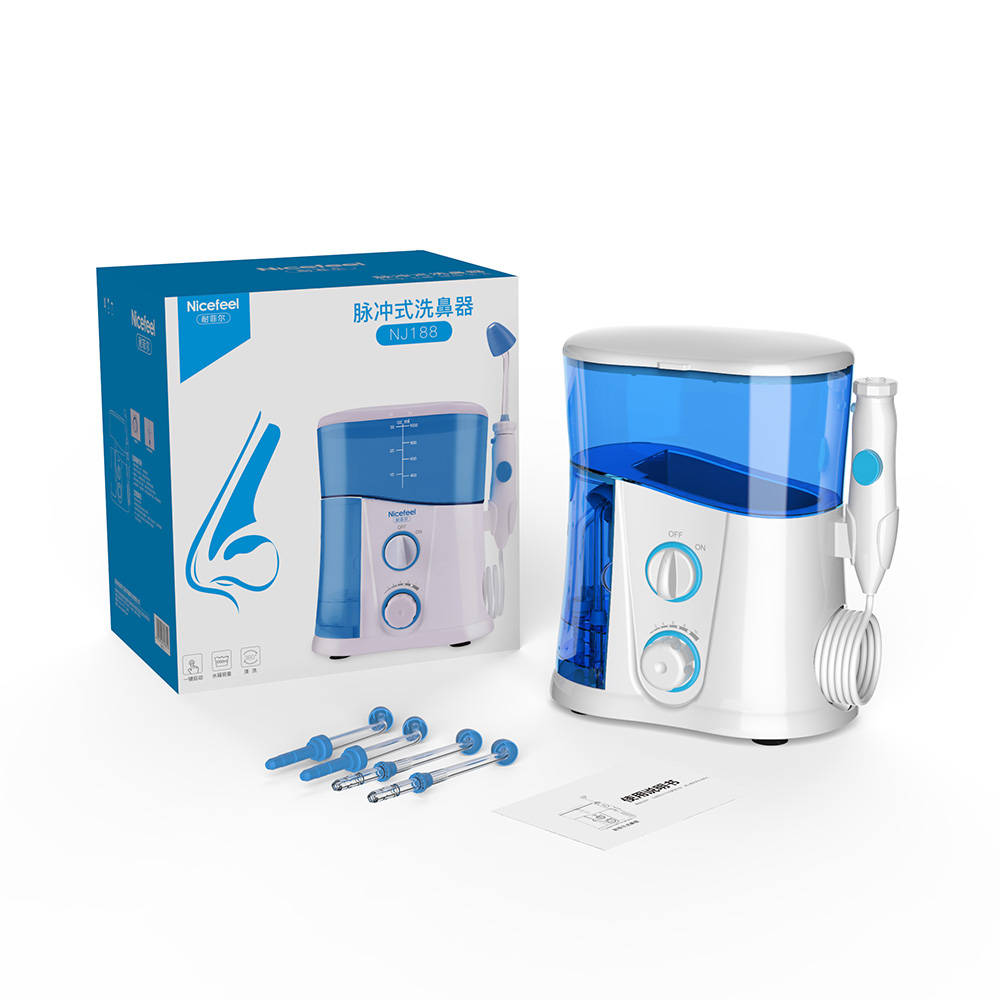
A modern nasal irrigation appliance is no longer defined only by whether it delivers saline through the nasal passages. Household buyers may also consider tank size, pressure adjustment, controls, nozzle options, noise, footprint, and cleaning convenience. For brands, the challenge is to turn these needs into a clear product concept rather than simply adding specifications.
The FDA identifies battery-operated pulsed water devices as one type of nasal irrigation device. Properly used irrigation can help rinse mucus, allergens, dust, and other debris, while safe water preparation and device cleaning remain essential parts of product use.

What Makes an Electric Nasal Cleaner Suitable for Home Use?
An electric nasal cleaner designed for household use should be easy to position, fill, operate, and clean. Countertop construction can accommodate a larger reservoir and stable base, which may suit households that value routine use over maximum portability.
Simple controls are equally important. Users should be able to start the appliance and adjust delivery without a complicated setup. A clear interface can support everyday use and make a product easier to explain in retail and product education materials.
Large-Tank Concepts for Family Routines
Tank capacity is one way to define a household-focused sinus flush machine. A larger reservoir can reduce interruptions during a session and support a product proposition centered on convenience.
The countertop range includes 600 mL configurations as well as a 1000 mL configuration. This creates room for different household positioning while retaining the countertop format. Buyers can match capacity with intended usage, available counter space, and overall product dimensions.
Adjustable Pressure and Flow
A second concept centers on control. Nasal irrigation is intended to deliver saline in a controlled manner, so products can differentiate through pressure or water-flow adjustment rather than simply maximizing output.
Several countertop configurations specify a 0–10 psi pressure range with 10-level water-flow adjustment. This approach gives buyers a straightforward feature story around adjustable operation and allows the user interface to become part of the product concept.
Smart Controls and Memory Functions
For a modern electric nasal cleaner, convenience can come from the control interface. Electronic switching, memory functions, and automatic shutoff can reduce repeated setup and make operation more predictable.
The NJ288 and NJ169 specify electronic switches with memory functions and automatic power-off after three minutes. These functions support a concept based on repeatable operation while keeping the control system straightforward.
Multi-Tip and Storage Concepts
Nozzle design also shapes product positioning. Different nasal jet tips can support different delivery formats, while built-in storage can help keep accessories organized in the bathroom.
The NJ288 specifies two professional nasal jet tips, while the NJ169 provides two types of nasal jet tips. The NJ166 and NJ188 include tip-storage features. For a sinus flush machine, these details can become part of a practical organization and usability proposition.
Balance Water Flow, Noise, and Footprint
Flow rate should be considered together with pressure because these specifications describe how saline is delivered. Countertop configurations use different water-flow ranges, allowing product concepts to emphasize particular operating characteristics.
Noise and footprint also matter in shared household spaces. The listed countertop models specify noise of no more than 75 dB, while dimensions and weights vary by configuration. Buyers can therefore evaluate acoustic performance alongside reservoir size, controls, and counter space requirements.
Waterproofing and Maintenance Expectations
Water resistance matters because irrigation products operate around liquid. The countertop configurations specify an IPX4 waterproof grade. However, an IP rating does not replace regular cleaning and drying.
The FDA recommends distilled, sterile, or previously boiled and cooled water for nasal irrigation and advises users to follow device instructions, clean the device, and dry it between uses. Product design and user education therefore need to work together.
How Flycat Supports Different Household Concepts
For brands evaluating an electric nasal cleaner, Flycat offers multiple countertop configurations that can be matched to different positioning strategies. Their range includes 600 mL models, a 1000 mL model, 10-level flow adjustment on selected products, multi-tip configurations, and electronic or mechanical control approaches.
The NJ288 combines a 600 mL tank, normal and pulse modes, 0–10 psi pressure, 10–425 mL/min water flow, and 1450±20% pulses per minute. The NJ188 provides a 1000 mL tank, 10-level flow adjustment, 40–380 mL/min flow, and the same 0–10 psi pressure range.
OEM/ODM Support for Sinus Flush Machine Development
A sinus flush machine may require different specifications depending on the target market, household use case, and retail positioning. Flycat states that they support OEM/ODM cooperation and product development from design and tooling through production and quality control.
Their company profile states that their manufacturing facility covers more than 20,000 square meters and includes more than 600 employees and over 40 R&D engineers. They also report more than 30 production lines and daily production capacity of up to 30,000 units.
Choosing a Clear Household Product Concept
The right electric nasal cleaner concept depends on which household needs the product is intended to address. One model may emphasize reservoir capacity, another adjustable flow, and another memory controls or accessory organization. A clear feature hierarchy can make the product easier to understand than a long list of disconnected specifications.
For businesses exploring a sinus flush machine, Flycat provides countertop configurations that can serve as starting points for comparison and customization. Their range allows brands to examine tank capacity, flow, controls, pressure, accessories, dimensions, noise, and waterproofing before defining a final product brief.
