
Future energy infrastructure will have to respond to more variation than traditional one-direction power systems were designed to manage. Renewable generation changes with weather, industrial loads rise and fall with production, electricity prices can vary by time, and critical facilities still require stable power when the grid is disturbed.
Industrial-scale battery storage technologies add a controllable buffer between these changing conditions. Instead of forcing supply and demand to match at every instant without support, batteries can move energy across time and give industrial sites more flexibility in how they interact with the wider power system.

Flexibility Is Becoming an Infrastructure Requirement
A power system with more variable generation needs resources that can respond when production and consumption do not line up. During periods of lower demand or available generation, commercial and industrial energy storage can absorb electricity and release it again as site demand rises.
At facility level, that flexibility can support load shifting and peak shaving; at a broader level, coordinated storage can reduce abrupt changes in power exchange with the grid. The key feature is controllability: stored energy is held until operating conditions justify using it.
Industrial-scale battery storage technologies are therefore relevant to infrastructure planning because they add a time dimension to electricity management. Wires and transformers move power from one place to another, but they do not store it for later use. Batteries can absorb a temporary surplus and release it during a shortfall, creating another tool for balancing changing conditions.
Their role is especially significant where industrial consumption, distributed generation, and grid constraints meet at the same connection point.
Resilience Depends on More Than Stored Capacity
A large battery cannot protect a facility merely because it contains many kilowatt-hours. Backup operation depends on power capability, switching behavior, protection settings, control priorities, and the definition of critical loads.
Commercial and industrial energy storage must be able to detect a change in grid conditions and move into the required operating state without creating unsafe or unstable electrical behavior. The quality of the transition can be as important as the amount of energy available after the transition occurs.
A resilience-oriented implementation can be seen in Dunext’s C&I solution, which uses six layers of protection from cell level through the overall system and supports on/off-grid transfer in under 20 ms for critical loads. These characteristics show how industrial-scale battery storage technologies can combine stored energy with fast system response.
The battery supplies the energy reserve, while protection and control determine whether that reserve can be used in a disciplined way. Resilience is therefore an architectural property of the complete storage system, not a simple consequence of capacity.
A Scalable Architecture Supports Changing Industrial Sites
Industrial energy requirements rarely remain fixed for the entire life of a facility. Production lines are added, equipment is electrified, photovoltaic capacity changes, and operating schedules evolve. A storage architecture with several capacity tiers can accommodate these differences more readily than a single rigid configuration.
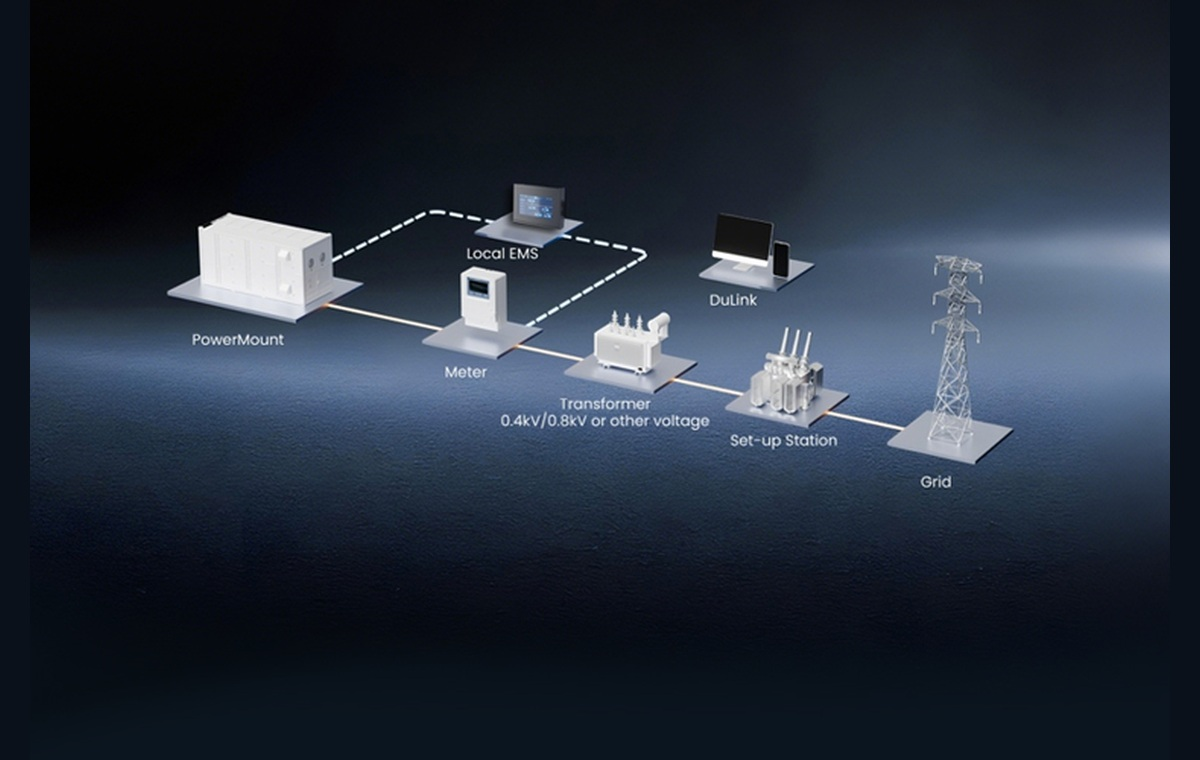
Dunext’s C&I portfolio spans multiple capacities from 20 kWh to 20 MWh through PowerHill, PowerRock, and PowerMount configurations, giving commercial and industrial energy storage a range of deployment scales rather than one uniform project size.
Digital coordination becomes more important as that equipment base grows. Site-wide dispatch in the C&I architecture is handled through a unified EMS, so storage can be scheduled alongside generation and other compatible site equipment. Operational visibility continues through DuLink, which brings web and app supervision together with remote O&M, proactive alerts, and intelligent diagnostics.
Within industrial-scale battery storage technologies, these functions support a shift from equipment ownership toward active energy operation, where the storage asset is continuously adjusted in response to the condition of the site.
Economic Operation and Grid Support Can Share the Same Asset
Storage economics depend on how often the battery is used, what objective each cycle serves, and whether different operating modes can coexist without undermining one another. A system may reduce short-duration demand peaks, shift consumption away from expensive periods, or participate in demand-response programs.
These operating models turn the battery into an active energy-management resource rather than equipment reserved only for emergencies. Commercial and industrial energy storage can therefore address both routine operating costs and resilience, provided the control strategy respects battery limits and backup priorities.
Dunext identifies intelligent peak shaving, load shifting, and demand response among the operating models supported by its C&I solution. That range shows why industrial-scale battery storage technologies are likely to remain relevant as energy infrastructure becomes more decentralized.
A facility can use the same storage architecture to manage internal loads, coordinate distributed resources, and change its pattern of grid interaction. The technical challenge is to schedule those uses so that one objective does not consume the energy or power reserve required by another.
Battery storage is critical to future infrastructure not because every industrial site will use it in exactly the same way, but because future power systems need controllable resources that can adapt to different conditions. Flexible charging and discharging, rapid mode changes, layered safety, scalable capacity, and digital dispatch give storage a role that extends beyond backup power.
Their infrastructure value ultimately rests on connecting resilience, operational flexibility, and grid interaction within one coherent architecture.
