
Selecting conformal coating materials for PCB protection requires evaluating environmental exposure, chemical resistance, temperature range, substrate compatibility, film formation, and curing requirements. Selecting automated conformal coating equipment is only part of the decision; coating chemistry, film thickness, curing behavior, and long-term reliability all influence the final result.
Axxonauto develops coating automation technologies that support controlled application, helping manufacturers match material performance with the practical demands of PCB production.

How to Match Coating Chemistry to Environmental Exposure?
Moisture, airborne contaminants, corrosive gases, and temperature fluctuations can affect electronic assemblies in different ways. A PCB installed in a climate-controlled indoor device may face relatively mild exposure, while automotive or outdoor electronics can experience repeated thermal cycling, condensation, and vibration. Material selection should begin with the actual service environment rather than a general preference for one coating type.
Acrylic coatings are often considered for applications requiring straightforward application and relatively easy rework. Silicone materials offer flexibility across broad temperature ranges, while urethane coatings can provide useful resistance to certain chemicals and environmental contaminants. These categories have different formulations, so performance should be assessed against specific product data rather than assumed from the chemistry name alone.
Chemical resistance is only one part of the assessment. A coating may tolerate moisture but still develop adhesion problems on a contaminated surface or around incompatible component materials. Engineers should review substrate compatibility, expected service temperature, electrical insulation requirements, and relevant environmental testing before approving a formulation for production.
| Coating type | Typical strength | Main limitation |
| Acrylic | Easy application and rework | Lower resistance to some solvents |
| Silicone | Flexibility and temperature range | Adhesion can vary by substrate |
| Urethane | Chemical and abrasion resistance | More demanding curing and repair |
How to Evaluate Application Behavior and Film Formation?
The way a coating flows can be just as important as its cured properties. Viscosity, surface tension, solids content, and solvent evaporation influence how the material spreads across solder joints, component edges, and narrow spaces. Poor wetting may leave exposed regions, while excessive flow can cause pooling around connectors or other areas that require protection.
Film thickness needs particular attention because more material does not automatically provide better protection. An overly thin layer may leave vulnerable areas insufficiently covered, whereas excessive thickness can contribute to trapped solvents, uneven curing, or unwanted accumulation. The appropriate range depends on the coating formulation, board geometry, and applicable product specifications.
The conformal coating process should also account for curing requirements. Some materials cure through solvent evaporation, while others rely on moisture, heat, or ultraviolet exposure, sometimes combined with a secondary curing mechanism. Production teams need to consider cure time, equipment compatibility, ventilation, and the effect of curing conditions on heat-sensitive components.
How to Validate Material Compatibility With PCB Design?
Component density and board geometry can complicate coating selection. Tall components, fine-pitch connectors, shielded regions, and narrow gaps create different flow and access conditions. Material properties that work well on an open test coupon may produce inconsistent coverage when applied to a densely populated assembly.
Compatibility testing should include the actual materials found on the PCB, such as solder mask, component encapsulants, labels, adhesives, and connector plastics. Certain formulations may cause swelling, discoloration, stress cracking, or adhesion loss on susceptible surfaces. Representative test assemblies provide more useful evidence than relying on a generic material description.
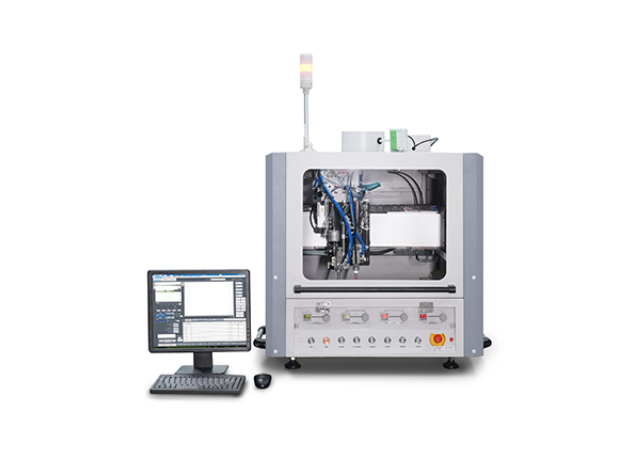
Laboratory-scale trials can help establish a suitable process before volume production begins. The MYC10 is a benchtop coating platform designed for prototyping and laboratory selective coating applications. Its three-axis motion system uses servo motors and precision ball-screw drives, with an optional four-position rotation and tilt unit for applications that require angled access. Such a setup can support controlled material evaluation, although the selected coating still requires application-specific validation.
Conclusion
Reliable PCB protection comes from matching material properties to environmental exposure, board construction, and the realities of the coating process. Engineers should compare technical data, conduct compatibility trials, and verify coverage and curing performance on representative assemblies before scaling up production.
Automated conformal coating equipment can improve application repeatability, but material suitability remains central to long-term protection. Axxonauto’s coating technologies provide options for controlled application across different production settings, with the final selection guided by the PCB’s requirements rather than by equipment specifications alone.
FAQs
Which Conformal Coating Material Is Best for PCB Protection?
There is no universal choice. Acrylic, silicone, urethane, and other formulations have different properties, so the decision should reflect environmental exposure, temperature range, chemical contact, repair requirements, and substrate compatibility.
Does Greater Coating Thickness Always Improve Protection?
No. Excessive thickness can create pooling, uneven curing, or other defects. The target film thickness should follow the material manufacturer’s specifications and be validated against the board design and service conditions.
Why Is Material Compatibility Testing Necessary?
Coatings can interact with solder masks, plastics, adhesives, and component surfaces. Testing helps identify adhesion problems, discoloration, swelling, or other unwanted effects before production volumes increase.
How Does Curing Method Affect Material Selection?
Curing requirements influence production time, equipment configuration, ventilation, and component temperature exposure. The coating chemistry and curing process must both suit the assembly and manufacturing environment.
Can Laboratory Trials Predict Production Performance?
Laboratory trials are useful for comparing materials and developing initial parameters, but they cannot represent every production condition. Validation should also consider actual PCB geometry, application speed, environmental controls, and inspection results. Axxonauto coating platforms can support material trials when their configuration matches the intended application.
