
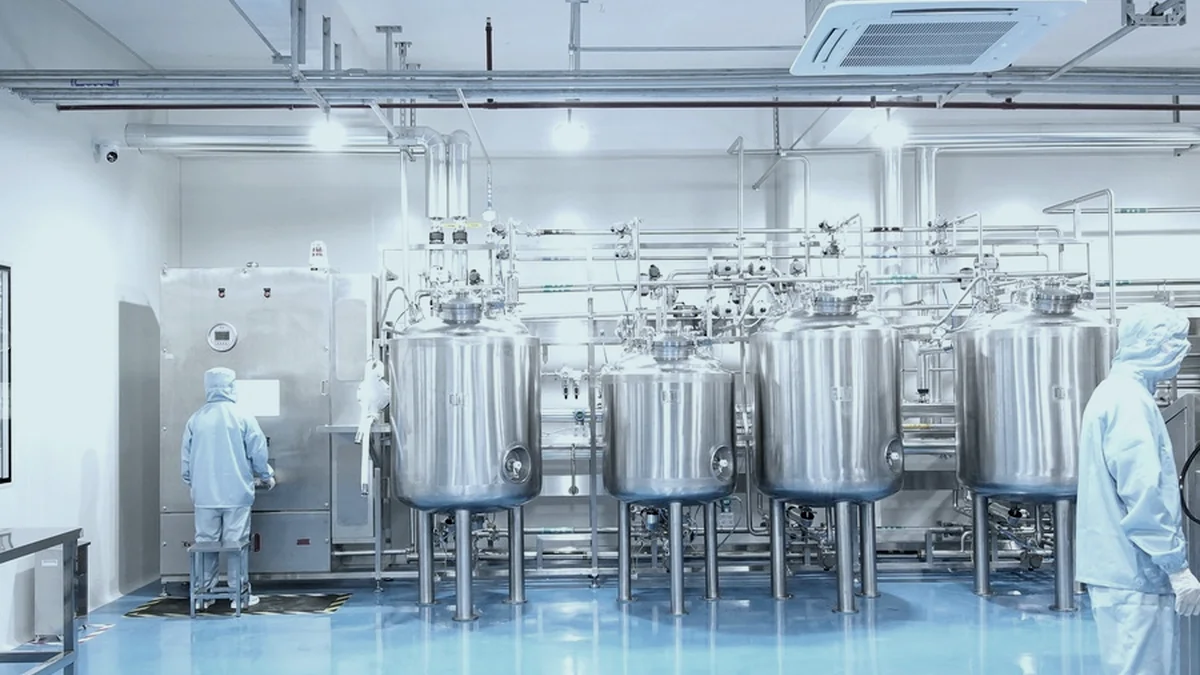
Custom peptide manufacturing becomes more challenging as production moves from laboratory experiments to commercial quantities. A synthesis route that produces the desired molecule at milligram scale may encounter significant limitations when transferred to kilogram-scale operations. Although coupling efficiency, raw material quality, and reaction control receive considerable attention, purification can become the decisive constraint on overall throughput, product quality, and manufacturing cost.
For pharmaceutical developers and biotechnology companies, successful scale-up requires more than increasing reactor capacity. Purification must remove closely related impurities while maintaining acceptable recovery, reproducibility, and cycle times. Understanding this challenge helps manufacturers develop more practical production strategies and select partners capable of supporting peptide industrialization.

Why Purification Becomes More Difficult at Scale
Solid-phase peptide synthesis (SPPS) involves sequentially adding amino acids to a growing chain attached to a solid support. Each coupling and deprotection step can generate impurities, including deletion sequences, incomplete products, and other related compounds. Side reactions and aggregation may introduce additional challenges, depending on the peptide sequence and process conditions.
As batch size increases, the amount of crude peptide entering purification grows substantially. Even when the percentage of impurities remains similar, the absolute impurity load can become much larger. Purification equipment, solvent consumption, filtration capacity, and analytical testing must accommodate that increase without compromising product specifications.
The challenge is particularly pronounced for long, hydrophobic, or structurally complex peptides. Their impurities may have properties very similar to those of the target molecule, making separation difficult. Consequently, purification performance can deteriorate even when synthesis itself appears technically successful.
Why Chromatography Can Limit Manufacturing Throughput
Preparative reversed-phase high-performance liquid chromatography (RP-HPLC) is widely used to purify synthetic peptides. It separates compounds according to differences in their interactions with a stationary phase and a liquid mobile phase. However, resolution depends on factors such as column chemistry, gradient conditions, loading capacity, and the characteristics of the crude mixture.
A method optimized for a small sample may not transfer directly to a larger column or higher sample load. Excessive loading can reduce resolution, while broader peaks may increase the volume of fractions requiring evaluation. Operators must balance throughput against purity and recovery rather than maximizing loading alone.
Large-scale purification also creates substantial solvent-handling demands. Solvent preparation, storage, recovery, waste management, and equipment cleaning can all affect production schedules. A large scale peptide synthesis strategy therefore needs to account for purification capacity from the earliest process-design stages, not only after synthesis has been optimized.
How Early Process Development Reduces Purification Risks
Purification should be considered during route design rather than treated as a final corrective step. Changes to coupling chemistry, protecting-group strategy, cleavage conditions, and reaction monitoring can influence the impurity profile presented to downstream operations. Reducing difficult-to-separate impurities upstream may improve recovery and reduce the number of purification stages required.
Effective peptide process development connects synthesis performance with downstream separation. Analytical HPLC and mass spectrometry can help characterize crude mixtures, identify major impurities, and evaluate whether a proposed method offers adequate selectivity. Loading studies and preparative trials then establish whether laboratory conditions remain suitable at larger volumes.
For developers planning peptide scale-up manufacturing, these studies provide practical evidence for equipment selection, batch planning, and cost estimation. A qualified large scale peptide synthesis service should therefore assess crude quality, purification yield, solvent demand, and cycle time together instead of evaluating synthesis output alone.
Strategies for Improving Purification Efficiency
Several approaches can help improve manufacturing performance, although the appropriate combination depends on the peptide and its impurity profile.
Optimize chromatographic conditions: Adjust stationary-phase chemistry, gradient slope, temperature, and loading to improve separation without sacrificing excessive recovery.
Evaluate alternative separation modes: Ion-exchange or mixed-mode chromatography may help when reversed-phase separation offers insufficient selectivity. These techniques require peptide-specific evaluation rather than automatic substitution.
Reduce impurity formation: Review coupling efficiency, reaction monitoring, and process conditions to limit impurities that are difficult to remove later.
Assess solvent use and cycle time: Consider solvent recovery, cleaning requirements, fraction handling, and equipment utilization when comparing process options.
Continuous or multicolumn chromatography may also improve resource utilization in suitable applications. However, implementation depends on process complexity, equipment availability, and the ability to maintain consistent product quality. Manufacturers should establish performance through experimental data rather than assume that a newer purification technology will automatically reduce costs.
Quality Control Must Remain Part of the Scale-Up Plan
A faster purification process is not necessarily a better one if it compromises impurity control. Peptide-related impurities can arise from starting materials, reagents, solvents, and manufacturing reactions. Their identity and levels must be evaluated against the intended product requirements and applicable regulatory expectations. The US Food and Drug Administration’s guidance on synthetic peptides highlights the importance of understanding and controlling peptide-related impurities.
Quality planning should define suitable analytical methods, acceptance criteria, sampling points, and documentation requirements. Process changes also need appropriate evaluation to determine whether they affect impurity profiles, recovery, or product consistency.
Experienced custom peptide services providers can help integrate analytical development, process optimization, and manufacturing controls. For commercial programs, a large scale peptide synthesis service should demonstrate how purification methods are evaluated and transferred, while peptide process development should establish the evidence needed to support reproducible production.
Building a Scalable Manufacturing Strategy with UTIDE
Purification capacity can determine whether a promising synthesis route becomes a commercially viable manufacturing process. For biotechnology companies and pharmaceutical developers, the priority is to establish a process that balances purity, recovery, throughput, and operating costs from the beginning.
UTIDE focuses on peptide industrialization, offering process development, scale-up development from milligram to multi-kilogram scale, quality systems, and global technical support. Its capabilities provide a starting point for companies evaluating custom peptide services and planning peptide scale-up manufacturing. By integrating peptide process development with purification planning, manufacturers can make more informed decisions when selecting a large scale peptide synthesis service and preparing for large scale peptide synthesis. Early collaboration helps identify downstream constraints before they become costly production bottlenecks.
