
Modern industrial manufacturing increasingly relies on intricate geometries that traditional subtractive machining cannot easily produce. Components featuring internal conformal channels, consolidated multi-part assemblies, thin-walled turbines, and porous lattice structures demand production methods capable of building geometry directly from digital CAD data. Selective Laser Melting (SLM), a core process within metal additive manufacturing, has emerged as a primary technology for fabricating these intricate components.
However, selecting appropriate equipment for highly complex geometries requires evaluating specific technical parameters rather than relying solely on general machinery ratings.

Understanding Geometric Complexity in Metal Powder Bed Fusion
Complex metal parts present distinct physical and thermal challenges during production. Fine internal features require precise laser spot control to avoid unintended powder fusion inside narrow channels. Simultaneously, steep overhangs and unsupported internal geometry depend on optimized scanning strategies and stable thermal dissipation across the build substrate.
When evaluating equipment capabilities for complex components, engineering teams typically focus on three core pillars: optical system precision, atmospheric stability within the build chamber, and powder layer uniformity. A deviation in any of these parameters can lead to internal void formation, geometric warping, or surface roughness that impedes fluid dynamics in internal passages. Substrate preheating and real-time process observation with feedback mechanisms are among the approaches that may help reduce thermal stress buildup over extended build cycles.
Key Technical Criteria for Selecting a 3D Printer for Metal Parts
- Optical Control and Beam Quality
The resolution of internal geometries depends heavily on the laser system configuration. Systems equipped with variable spot size controls (typically ranging from 50 μm to 120 μm) allow fine contouring on delicate features while utilizing wider spot profiles for rapid core hatch melting. Dual-laser systems with dynamic optical synchronization increase build throughput while maintaining consistent thermal distribution across the build area.
- Atmosphere and Oxygen Management
Reactive materials such as titanium alloys and superalloys are highly sensitive to oxygen exposure at elevated temperatures. To ensure dense material properties and prevent oxidation defects in fine lattice struts, the print chamber must maintain a controlled gas environment. Industrial systems frequently utilize continuous inert gas circulation (Argon or Nitrogen) to keep chamber oxygen levels at or below 100 ppm, paired with high-efficiency multi-stage filtration to remove soot and airborne spatter.
- Layering Uniformity and Powder Management
Thin layer deposition, ranging from 20 μm to 120 μm, allows precise detail reproduction on inclined surfaces and complex curvatures. Automatic powder feeding, precise recoater positioning, and integrated powder screening mechanisms ensure consistent powder packing density, which minimizes internal porosity in stress-bearing components.
Spotlight on High-Precision Industrial Equipment
In the industrial equipment sector, technology enterprise LiMN 3D focuses on metal powder bed fusion equipment, materials development, and custom OEM/ODM engineering services. The company supplies specialized equipment designed to meet rigorous manufacturing requirements across aerospace, automotive, medical, mold making, and research applications.
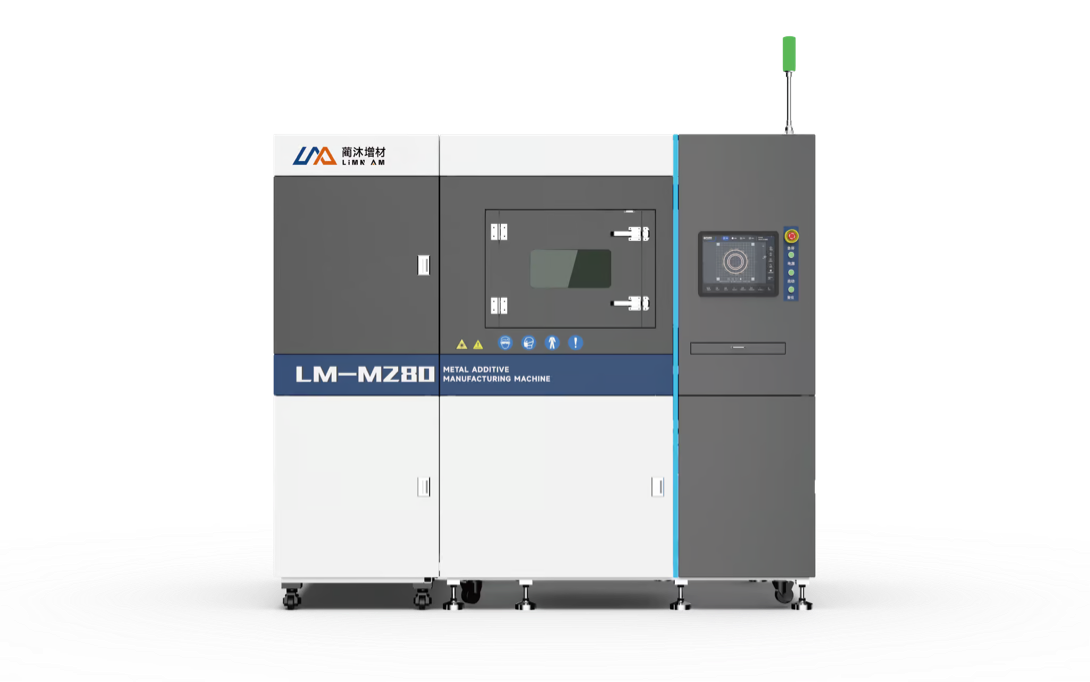
An example of machinery designed for high-precision components is the LM-M280, an industrial 3d printer for metal parts engineered for small to medium-sized complex components. Available within the LM-M280 series are multiple configurations, with build envelopes, dual 500W fiber lasers or custom optical options, and dynamic scanning speeds that can reach 7 m/s depending on the selected variant.
The LM-M280 supports layer thicknesses between 20 μm and 120 μm with an adjustable light spot diameter from 50 μm to 120 μm. It achieves maximum build rates up to 35 cm³/h while operating under a controlled atmosphere with chamber oxygen levels maintained ≤100 ppm. Equipped with a three-stage filtration system offering 99.95% efficiency for 3 μm particles, the unit supports demanding technical alloys including titanium alloys, high-temperature superalloys, stainless steel, die steel, and aluminum alloys.
Real-World Industrial Application Scenarios
Industrial manufacturers deploy metal powder bed fusion systems across several high-demand application sectors:
Aerospace Components: Intricate fuel nozzles, heat exchangers, and bracket assemblies utilize consolidated designs to reduce total part count and overall weight while maintaining structural strength under extreme thermal cycles.
Conformal Cooling Injection Molds: Tooling manufacturers integrate curved cooling channels directly inside injection mold inserts and shoe mold dies. Matching passage geometry to part contours significantly improves heat extraction, shortens molding cycle times, and minimizes part warping.
Medical Orthopedic Implants: Patient-matched spinal cages, acetabular cups, and orthopedic scaffolds incorporate engineered porous lattice structures. These porous surfaces simulate natural bone architecture to encourage cellular ingrowth.
Automotive and Consumer Electronics: Fluid distribution manifolds, electric motor cooling jackets, and specialized heat sinks with complex internal pin fins benefit from direct fabrication without needing assembly welds or casting cores.
Key Technical Questions B2B Buyers Ask
How does variable spot diameter impact fine internal feature resolution?
A smaller laser spot diameter (such as 50 μm) concentrates energy into a refined region, enabling sharp corner definition and clean boundary edges on delicate lattice structures or thin walls. Wider spot diameters used for inner hatching can help improve build efficiency, with careful parameter tuning to preserve external edge fidelity.
Why is controlled gas circulation critical for internal channels?
During laser melting, metallic condensate and airborne spatter are generated in the chamber. Without directional, high-efficiency gas flow, spatter can settle inside narrow internal channels or scatter the laser beam, leading to micro-voids or localized channel blockages.
How do multi-laser systems maintain consistent material properties across overlap zones?
The LM-M400 multi-laser system supports optical calibration and path management algorithms for overlapping scan regions. By coordinating laser power and beam movement across designated overlap zones, the system maintains consistent energy input, preventing microstructural inconsistencies between laser field boundaries.
Strategic Conclusion for Industrial Procurement
Selecting equipment for complex metal component production requires balancing build volume, optical precision, and atmospheric control. By prioritizing systems with reliable oxygen management, flexible optical configurations, and broad material support, engineering teams can successfully scale production of intricate parts across aerospace, medical, and tooling applications.
