
It is easy to fixate on tile selection—porcelain versus ceramic, matte versus gloss, herringbone versus stack—while treating the ancillary components as afterthoughts. Yet anyone who has walked past a shower niche with raw tile edges, a corner where two materials meet without transition, or a grout joint that has cracked along a stress line understands that accessories determine whether an installation looks finished and performs durably.
Bathroom tile accessories—edge trims, movement joints, waterproofing tapes, and precision spacers—are not decorative add-ons. They are structural necessities that manage moisture, accommodate thermal movement, and protect exposed edges from impact and abrasion. Specifying them with the same rigor applied to the primary tile surface is the difference between an installation that lasts and one that deteriorates within seasons.
Edge Profiles and Trim Pieces for Exposed Terminations

Where a tiled surface terminates against a different material or an open edge, the cut side of the tile is exposed. This reveals the porous body, creating a vulnerable impact point and presenting an unfinished visual line. Edge profiles, whether in aluminum, stainless steel, or PVC, cap this raw edge while providing a clean linear transition. Bullnose tiles, with their factory-rounded edges, serve a similar function but require precise alignment with field tiles. In wet environments, the profile material must resist corrosion and accommodate the differential expansion between the tile body and the substrate. The profile height must also match the tile thickness exactly to avoid lippage or shadow gaps.
JLA Ceramics manufactures bathroom tile accessories that address these exact edge-finishing requirements. The company’s trim and profile offerings are dimensioned to correspond with standard tile thicknesses, ensuring flush transitions. This integration maintains both waterproofing integrity and visual continuity across the entire installation.
Corner Treatments and Material Transitions
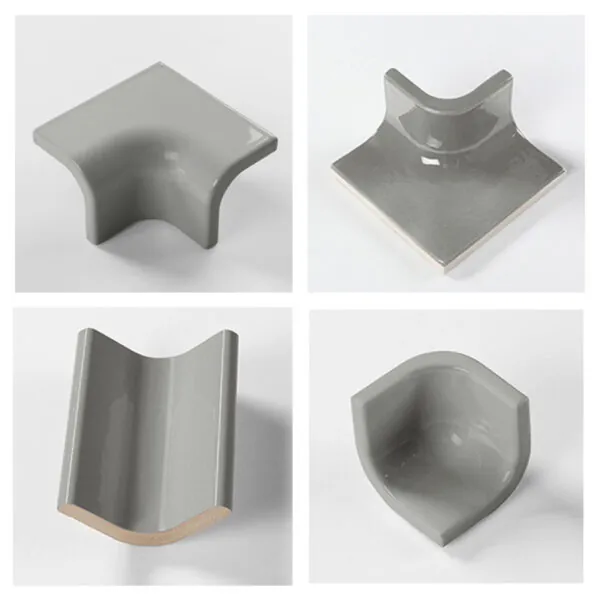
Internal and external corners in bathroom installations present distinct challenges. Internal corners in shower enclosures must accommodate silicone movement joints that prevent grout cracking as the structure settles or thermally cycles. External corners—such as half-walls or pony walls—require protection from impact and abrasion that would chip glaze and expose the tile body. Transition strips between tile and adjacent flooring materials manage height differentials and create a safe, trip-resistant edge. In each case, the accessory must be specified during the design phase so that tile layouts can be planned around the required clearances and joint widths.
JLA Ceramics offers tile accessories including corner pieces and transition profiles. These products are produced to correspond with the dimensions of the company’s primary tile ranges, supporting coordination between accessories and field tiles during installation.
Waterproofing Membranes, Tapes, and Drain Integrations
A bathroom floor is only as waterproof as the layer beneath the tile. Sheet membranes, liquid-applied coatings, and fleece-backed sealing systems create a continuous barrier between the substrate and the tile assembly. Critical failure points occur at pipe penetrations, drain flanges, and wall-to-floor junctions. These are areas where prefabricated collar accessories and reinforced sealing tapes are essential. The waterproofing system and tile adhesive must be chemically compatible; incompatible combinations can degrade the membrane or prevent proper bonding. Drain grates and channel covers, often selected for aesthetics, must also accommodate the anticipated water flow rate and be removable for maintenance access.
While JLA Ceramics specializes in ceramic surfacing, the company’s technical support extends to guidance on waterproofing compatibility and installation sequencing. This systems-level approach helps installers coordinate tile work with the underlying moisture barriers. Proper planning ensures that the building structure remains protected over the long term.
Movement Joints and Expansion Control
Ceramic and porcelain tiles are dimensionally stable, but the substrates beneath them—concrete, plywood, cement board—expand and contract with temperature and humidity changes. Without engineered movement joints, this differential stress transfers to the tile and grout, resulting in cracks, delamination, and efflorescence. Perimeter joints along walls and fixtures, field joints at regular intervals in large floors, and structural joints over control joints in the substrate are all necessary. Prefabricated movement joint profiles with replaceable inserts accommodate cyclic movement while maintaining a finished appearance that does not disrupt the visual field.
JLA Ceramics subjects every batch to quality checks covering flatness and color consistency. Predictable tile dimensions support more effective movement joint spacing, as significant size variation can complicate installation alignment regardless of accessory placement.
Spacers, Leveling Systems, and Installation Precision
Consistent joint width is not merely an aesthetic preference; it determines grout performance. Irregular joints create weak points where grout can crack or where moisture penetrates unevenly. Cross-shaped spacers in graduated sizes establish uniform grout lines during installation. For large-format tiles, clip-and-wedge leveling systems prevent lippage by holding adjacent tiles flush while adhesive cures. In bathroom floors with integrated linear drains, slope guides and leveling accessories ensure that the finished surface directs water toward drainage points without visible humps or depressions that would create pooling.
Installers working with JLA Ceramics tile products benefit from technical documentation that specifies recommended joint widths, substrate flatness requirements, and compatible setting materials. This guidance reduces the likelihood of installation errors. Proper planning protects the performance of both the tile surface and its associated bathroom tile accessories.
Sourcing Bathroom Tile Accessories for a Complete Installation
A fragmented supply chain—sourcing tiles from one supplier, trims from another, and waterproofing materials from a third—introduces compatibility risks and logistical complexity. Dimensional mismatches between tile thickness and profile height, color variations between batches of grout, and incompatible adhesive formulations are common consequences. Buyers who treat the tile and its accessories as a unified specification achieve more predictable outcomes. The supplier should provide not only the products but also technical documentation, installation best practices, and compatibility matrices that coordinate the entire assembly.
JLA Ceramics is a professional tile manufacturer that supplies bathroom tile accessories—including edge profiles, corner pieces, and trim elements—alongside its primary tile collections. These accessories are produced to correspond with the dimensions of the company’s main product ranges. With quality checks, export logistics experience, and after-sales technical support, JLA Ceramics offers the components that support coordinated bathroom installations.To browse coordinating tile accessories and trim profiles, visit JLA Ceramics.
