
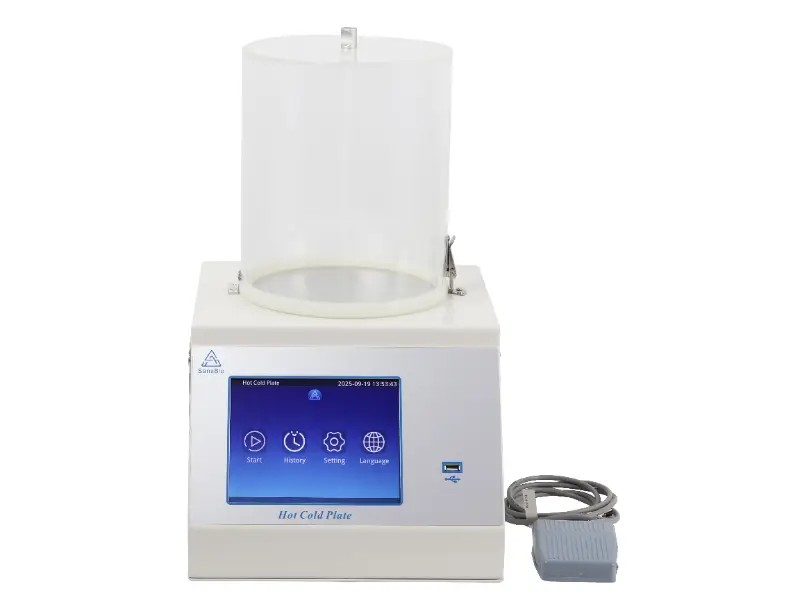
A hot plate assay examines behavioral responses to controlled thermal stimulation in mice. Researchers need to standardize plate temperature, exposure limits, endpoint definitions, and timing. Variations in these conditions can affect latency measurements and interpretation of treatment and control groups.
Set the Temperature for a Mouse Hot Plate Test
Temperature is central to a mouse hot plate test. The selected setting should fit the experimental objective and approved animal-care protocol. Researchers should state whether the study uses a fixed or progressive temperature approach and record the settings with each session.

The SA705 Hot/Cold Plate Analgesia Meter supports temperatures from -5.0°C to +65.0°C, adjustable in 0.01°C steps. It provides fixed and progressive temperature modes and uses a 32-bit microcontroller with PID temperature regulation. Continuous temperature feedback adjusts heating or cooling according to plate temperature.
Establish an Appropriate Cutoff Time
Cutoff time defines the maximum exposure permitted when the target response has not occurred. It should be specified before formal testing and applied according to the study protocol and animal-welfare requirements.
The SA705 provides a time display range of 0.01–600.00 seconds and starts or stops testing through a foot pedal switch. The system records experimental time and temperature along with mean, maximum, and minimum values.
The appropriate cutoff remains a study-specific decision based on temperature, endpoint, and approved procedures.
Define the Response Before Data Collection
Response scoring should be established before the first formal trial. The behavioral endpoint needs a clear definition so different operators can recognize the same event. Researchers may monitor paw withdrawal, paw licking, or jumping as responses to thermal stimulation.
The SA705 records response latency for paw withdrawal, licking, or jumping at 0.01-second resolution through the foot pedal. A predefined scoring rule can make latency measurements more consistent and reduce ambiguity when more than one response occurs during a session.
Keep Temperature and Latency Together
A latency value is easier to interpret when its testing conditions are preserved. Researchers should associate each result with the target temperature, temperature mode, animal identifier, trial timing, and response category. This record is useful when comparing multiple groups or repeated sessions.
The SA705 records time and temperature as experimental data and stores up to 100 data records. Results can be exported to a USB flash drive in CSV format for review in Excel or compatible statistical software. The touchscreen also displays temperature, timing, curves, and stored results.
Standardize the Test Environment
The thermal plate is one part of the experimental setup. Researchers should also consider acclimation, handling sequence, observation conditions, cleaning procedures, and testing order. Documenting relevant variables can help distinguish treatment-related changes from differences in the testing process.
The SA705 is designed for mouse and rat hot plate tests as well as cold plate tests, thermal hyperalgesia, and cold allodynia studies. It uses a metal temperature plate and a cylindrical restrainer, with an apparatus size of 350 × 300 × 485 mm. Its sound level is below 60 dB(A).
Know the Limits of a Single-Plate Setup
The type of thermal apparatus should match the experimental paradigm. A single-plate test measures responses to the temperature presented on that plate, while a two-zone preference experiment requires access to two temperature conditions.
The SA705 is a single-plate system and does not automatically measure an animal’s preference between two temperature zones. For automated two-zone studies, the SA707 Thermal Place Preference System is the designated solution.
Review Data Handling Before Purchase
For laboratories running multiple cohorts, data management can be as important as temperature control. Researchers should check how results are saved, how much internal storage is available, and whether files can be moved into their existing analysis workflow.
The SA705 operates independently through its built-in 8-inch capacitive LCD display, while PC software is also available for laboratories that prefer remote control and analysis. Data export uses USB flash storage in CSV format. These options can support standalone testing or a computer-based laboratory process.
Build a Traceable Testing Workflow
A repeatable mouse hot plate test connects the thermal setting, exposure limit, response definition, timing method, and data record. Recording these elements together gives researchers a clearer basis for reviewing differences between animals, groups, and sessions.
BioMed Easy Technologies develops laboratory animal and neuroscience research equipment, and its parent company is SANS Biotechnology. Founded in 2016, the company held 2,200 m² of R&D and manufacturing space by 2017 and expanded its manufacturing center to more than 7,000 m² in 2024.
Its products are used in 3,000+ universities and 1,000+ research institutes and hospitals globally.
Its portfolio covers Motor Coordination, Pain and Inflammation, Learning & Memory, Anxiety, Fear & Emotion, Reward & Addiction, Video Tracking, Food & Drink, Metabolism, Physiology & Neurosurgery, and Animal Care.
Programmable heating and cooling, 0.01°C adjustment steps, foot-pedal timing, onboard data storage, and USB CSV export come together in the SA705, a standalone thermal system for hot plate studies. Contact BioMed Easy to discuss the appropriate configuration and workflow for your mouse hot plate research.
