
Modern industrial operations rely heavily on optimized environments to maintain high efficiency and protect personnel. Within logistics centers and storage facilities, visual clarity plays a foundational role in everyday performance. Outdated fixtures often cause uneven illumination, flickering, and shadows, leading to a higher risk of workplace accidents and slower task execution.
Upgrading to modern led lighting solutions for warehouse environments addresses these fundamental operational challenges. Advanced illumination systems provide bright, uniform light distribution that minimizes blind spots in aisles and loading docks.

By investing in tailored retrofits or new installations, facility managers can create a safer workspace that naturally fosters better employee focus. The shift away from legacy high-bay fixtures directly supports smoother workflows, fewer errors in inventory management, and a marked reduction in maintenance-related downtime, making visual environment optimization a strategic priority for industrial enterprises.
Mitigating Hazards Through Superior Visual Comfort
Safety remains the top priority in any high-traffic industrial facility. Forklift operators and warehouse personnel navigate narrow aisles shared with heavy machinery, making visibility a critical factor in accident prevention.
Older fluorescent or HID lighting typically suffers from rapid lumen depreciation and severe glare, which strains operators’ eyes and increases the likelihood of collisions. Modern optical designs resolve these issues through controlled light distribution.
For instance, advanced fixtures feature Unified Glare Rating (UGR) levels below 16, offering ultra-low glare that protects workers’ vision during long shifts. High Color Rendering Index (CRI) values above 80 help staff accurately read color-coded labels and warning signs.
When employees can see their surroundings clearly without squinting or navigating through dark patches, the incidence of trip hazards and equipment mishandling drops significantly.
Furthermore, modern setups often integrate emergency power supplies directly into the circuit. In the event of a power failure, integrated modules provide up to 180 minutes of emergency duration, guiding staff safely to exits.
Driving Operational Efficiency with LED Light Trunking
Beyond physical safety, the quality of light directly impacts how quickly and accurately tasks are completed. Order picking, packing, and quality control require continuous concentration. Poor lighting causes fatigue, which slows down cognitive processing and physical response times.
High-efficacy luminaires can reduce the electrical power required to provide a given amount of light, while appropriate illuminance and glare control can support visual working conditions.
Additionally, operational efficiency includes the time and resources spent on facility maintenance. Traditional lighting requires frequent bulb replacements and complex wiring troubleshooting, forcing managers to halt sections of the warehouse and deploy aerial lifts.
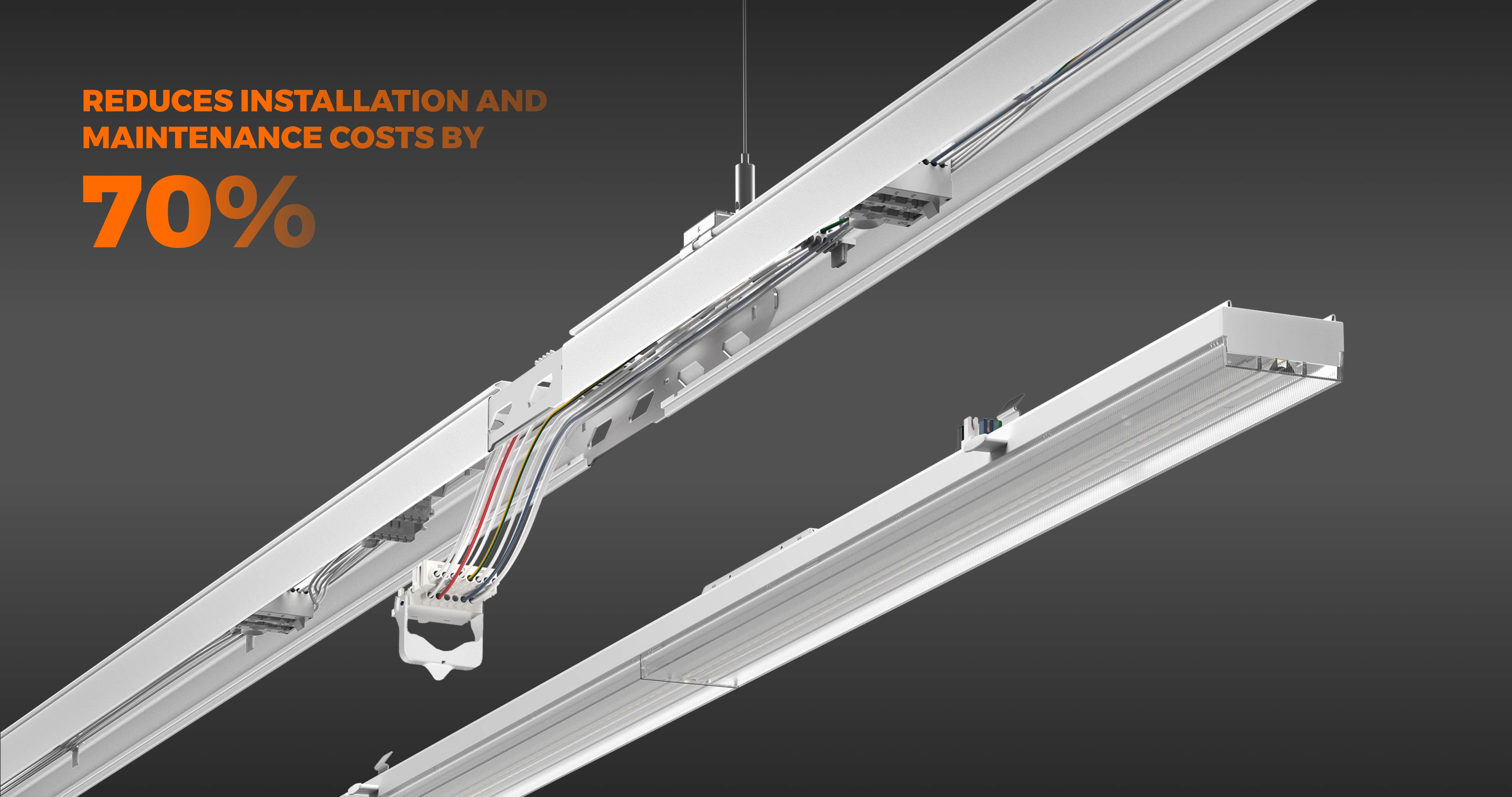
A continuous led light trunking configuration drastically reduces this burden. By utilizing a snap-fit design with dual push-button clips, facility teams can execute tool-free installation and removal.
Maintenance that previously took hours can be completed in minutes. Upgrading the lighting infrastructure means fewer interruptions to the daily workflow, allowing the logistics team to focus strictly on throughput and order fulfillment.
Specifications and Integration for Large-Scale Facilities
Selecting the appropriate retrofit requires evaluating both the physical demands of the space and the technical capabilities of the fixtures. Industrial spaces demand robust, scalable infrastructure.
The Fixed Style Trunking Light System, designed for large-scale environments, exemplifies how engineering advancements meet these demands. This system supports 176-meter ultra-long cascading, meaning a single continuous track can illuminate expansive warehouse footprints while reducing wiring costs by over 70% compared to traditional T8 batten setups.
This specific system features an impressive 11,880-lumen output, making it highly effective for main spatial illumination from high ceilings. Facility managers also benefit from adjustable settings.
The system incorporates a DIP switch design, providing seven selectable power levels ranging from 30W to 74W, allowing for customized brightness based on specific zone requirements. Multiple wire count options—including 5-wire for non-dimmable needs, 8-wire for dimming and emergency, and 12-wire for central emergency integration—offer the flexibility required for complex logistical centers.
Because each module features a snap-on power connection, a 120-module installation can be completed in just 30 minutes. This plug-and-play capability empowers businesses to upgrade their facilities rapidly.
Preparing Industrial Spaces for the Future
The transition to intelligent illumination is an ongoing evolution for the industrial sector. Incorporating smart controls, such as DALI digital dimming, 1-10V analog dimming, and wireless infrared motion sensors, adds another layer of functionality.
Lights can automatically adjust based on human presence or ambient daylight, minimizing energy waste in unoccupied aisles. Such IoT integration turns a simple lighting track into an active component of the building’s energy management strategy.
By adopting systems built for seamless integration, commercial spaces position themselves for long-term sustainability.
The European market certifications and ErP Class B energy-saving standards backing these high-grade products indicate rigorous testing and reliable performance. When companies invest in premium, custom-developed retrofit solutions, they lay a foundation that supports future technological upgrades without requiring full infrastructure replacement.
Strategic Value of Upgrading Facility Illumination
Optimizing the visual environment within a logistics or production center yields measurable returns beyond basic utility savings. The combination of ultra-low glare, high luminous flux, and seamless integration directly influences daily operational success.
Workers experience less fatigue and navigate their zones with heightened spatial awareness, translating into a noticeable drop in workplace incidents. Simultaneously, the drastic reduction in installation time and long-term maintenance overhead allows facility managers to allocate resources more effectively.
For organizations seeking reliable, turn-key professional retrofit solutions, partnering with TRIECO provides access to cutting-edge manufacturing and scalable designs. By implementing high-grade, intelligent lighting networks, industrial enterprises can cultivate a safer, highly productive workspace that meets the rigorous demands of modern supply chains.
