
Table of Contents
Yes, advanced chemical bonding in 2-shot liquid silicone rubber injection molding effectively eliminates the need for mechanical interlocks on compatible thermoplastic substrates. By utilizing specialized self-adhesive LSR grades and precise thermal management, manufacturers can achieve a covalent bond at the molecular level directly within the mold. This capability removes the requirement for physical anchors like through-holes or undercuts, streamlining the design process and significantly enhancing the sealing performance and structural integrity of high-precision components used in medical and automotive applications.
Chemical Bonding Mechanics in Liquid Silicone Rubber Injection Molding
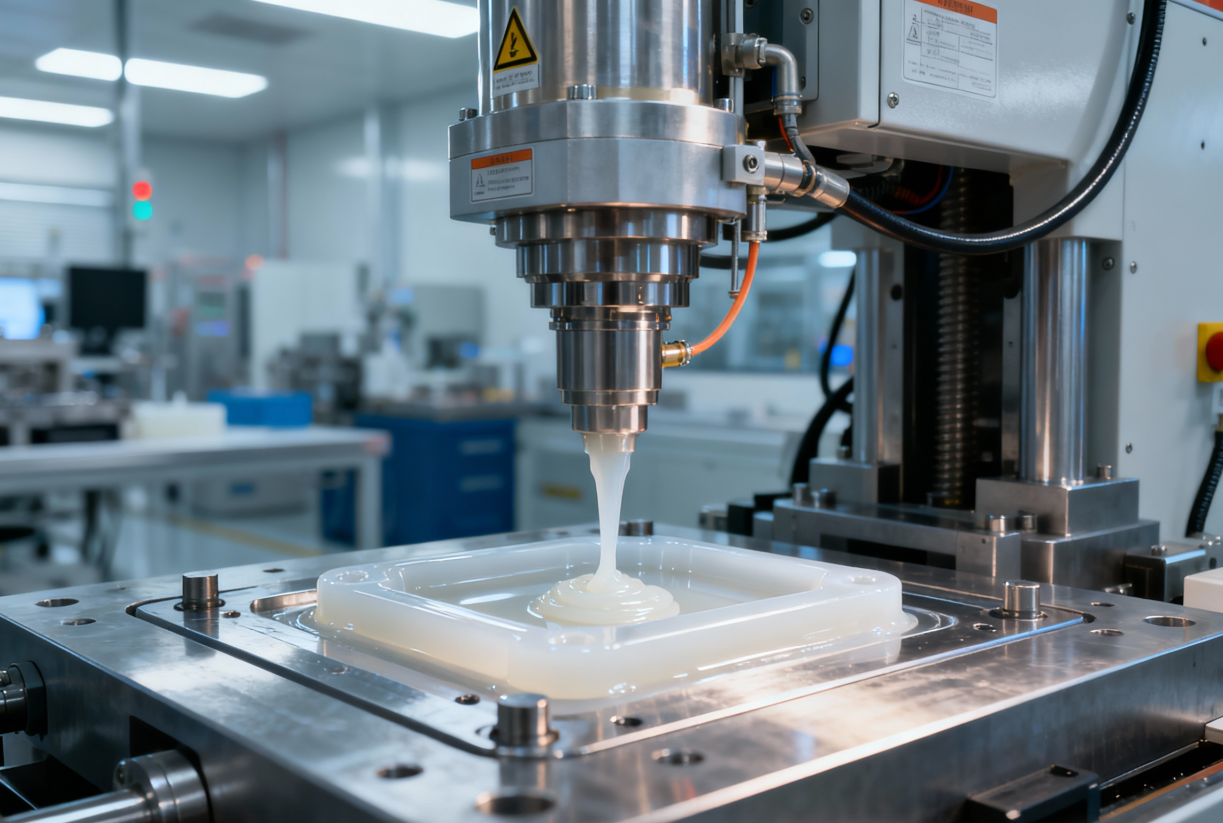
To replace physical locks, engineers must leverage the molecular engineering occurring inside the liquid silicone rubber injection molding machine, achieving adhesion without primers or mechanical retention features.
Covalent Bonding vs. Mechanical Interlocks
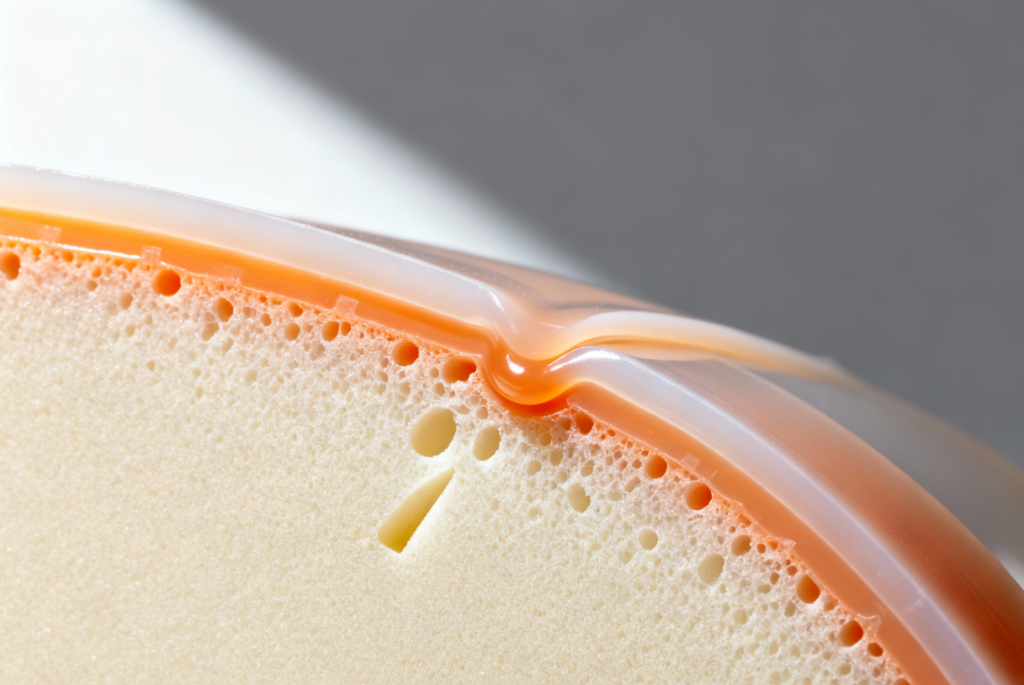
The transition from mechanical interlocks to chemical bonding relies on generating a specific reaction between the silicone and the plastic substrate during vulcanization. In traditional insert molding, designers rely on macroscopic features—such as undercuts, through-holes, or dovetail grooves—to physically trap the silicone. However, in advanced custom liquid silicone rubber injection molding, self-adhesive LSR grades contain silane-based adhesion promoters. Under heat and pressure, these promoters migrate to the interface and initiate a radical cross-linking reaction with active functional groups on the thermoplastic surface.
This process forms permanent covalent bonds that often exceed the tear strength of the silicone itself, typically achieving peel strengths greater than 10 N/mm. Unlike mechanical locks, which can allow micro-gaps to form due to differential thermal expansion (leading to leakage or bacterial growth), chemical bonding creates a continuous, hermetic seal. This is critical for IP67/IP68 rated devices and medical components where hygiene is paramount.

Thermal Management and Process Control
Achieving this bond requires the liquid silicone rubber injection molding machine to maintain rigorous temperature controls. The mold cavity must reach activation temperatures (typically 120°C–200°C) to energize the substrate surface without deforming it. Furthermore, the process demands precise synchronization; the LSR must be injected and cured while the substrate is still thermally active but stable. If the LSR cures too quickly (“skinning”) before contacting the substrate, the bond will fail. Advanced closed-loop systems monitor these variables in real-time to ensure shot-to-shot consistency.
Manufacturing and Material Prerequisites for Success
Successful chemical bonding requires strict compatibility matching and strategic sourcing from a capable liquid silicone rubber injection molding manufacturer to balance technical requirements with production costs.
Material Compatibility Standards
Chemical bonding is not universal; it demands specific pairing of LSR grades with high-temperature thermoplastics. Substrates must withstand curing temperatures while possessing the necessary functional groups for adhesion.
Polyamide (PA) and PBT: These engineering plastics are widely used in automotive connectors due to their thermal stability and chemical receptivity to self-adhesive LSR.
Polycarbonate (PC): Frequently used in consumer electronics, PC requires specific LSR formulations designed to “bite” into its surface energy.
When direct bonding is challenging, a liquid silicone rubber injection molding company may employ auxiliary processes like plasma surface activation to increase surface energy prior to overmolding, ensuring robust adhesion without mechanical locks.
Strategic Sourcing and China Rubber Injection Molding
Transitioning to 2-shot chemical bonding often involves higher initial tooling costs due to the complexity of rotating platen or core-back molds. Leveraging China rubber injection molding expertise allows companies to mitigate these costs. Chinese manufacturers often provide a significant cost advantage in high-precision tooling fabrication while maintaining adherence to ISO standards. By integrating a localized supply chain for specialized LSR materials, these manufacturers reduce lead times for prototype-to-production ramps, offering a viable path for scaling complex, bonded components efficiently.
Advanced LSR Solutions by Livepoint Tooling
Livepoint Tooling delivers precision custom liquid silicone rubber injection molding services, leveraging over 23 years of expertise to solve complex adhesion challenges for global industries.
One-Stop Manufacturing Excellence
Livepoint Tooling distinguishes itself by offering a comprehensive solution from initial concept (“napkin sketch”) to mass production. The company possesses in-house high-precision mold manufacturing capabilities, ensuring the precise alignment required for two-color injection molding. Whether the project requires complex multi-cavity tools or rapid prototyping, Livepoint provides integrated services including:
2-Shot & Overmolding: Seamlessly bonding LSR to rigid substrates for soft-touch grips and functional seals.
Insert Molding: integrating metal or plastic inserts with high-performance rubber.
System Integration: Combining CNC machining, EDM, and injection molding under one roof to streamline supply chains.
Industry-Specific LSR Capabilities
Livepoint’s engineering team creates tailored solutions for demanding sectors. In the medical field, they offer cleanroom-capable manufacturing for biocompatible components, ensuring safety and compliance. For the automotive and new energy sectors, they produce high-heat resistant gaskets and seals, demonstrated by their collaboration on the world’s first UHV hybrid insulator. Certified to ISO 9001 and IATF 16949, Livepoint ensures every component meets rigorous quality standards, making them a trusted partner for mission-critical applications.
To determine if your specific component design qualifies for chemical bonding and to receive a detailed Design for Manufacturability (DFM) analysis, contact our engineering team today.
