
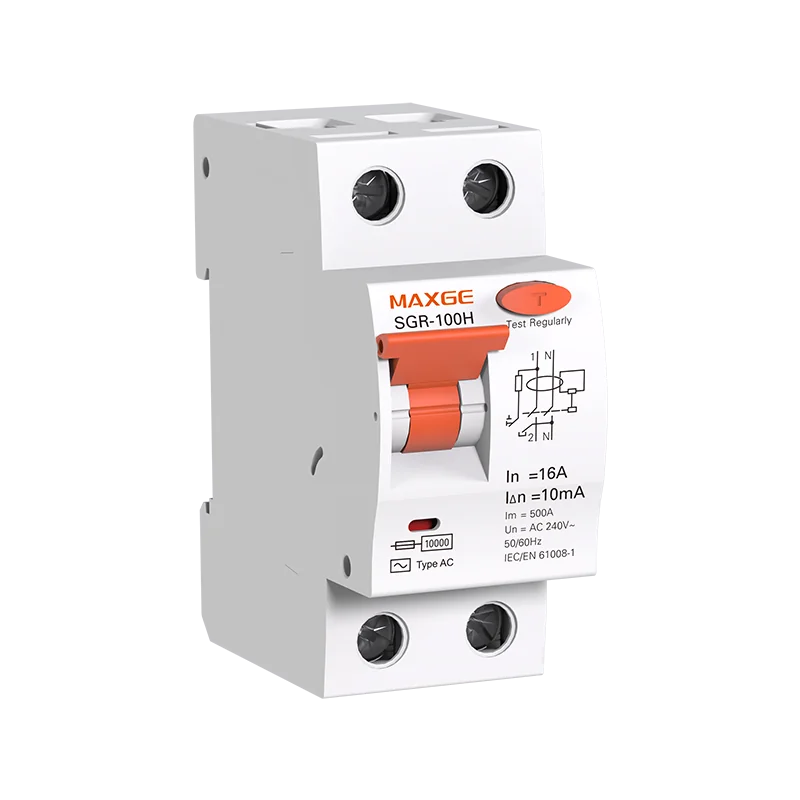
Electrical safety requirements vary according to circuit design, load characteristics, installation environment, and the level of protection required. When selecting electrical control products, one common question is whether to use a residual current circuit breaker (RCCB) or an RCBO. Although both devices provide residual-current protection, they are designed for different protection strategies.
Understanding the differences between these devices can help engineers, installers, and electrical system planners choose a practical solution without adding unnecessary complexity to the distribution system.

What Is a Residual Current Circuit Breaker?
A residual current circuit breaker is designed to detect current leakage caused by an imbalance between the live and neutral conductors. When the residual current reaches the specified operating threshold, the device disconnects the circuit to reduce the risk of electric shock and other leakage-related hazards.
RCCBs are commonly used together with miniature circuit breakers or other overcurrent protection devices. This arrangement allows the RCCB to focus on residual-current protection while a separate protective device handles overload and short-circuit conditions.
For example, the MAXGE SGR-2 series is designed according to EN/IEC 61008-1 and offers rated currents from 16A to 80A, with residual-current sensitivity options including 10mA, 30mA, 100mA, and 300mA. It is available in 2P and 4P configurations for different circuit arrangements.
When Does an RCBO Make More Sense?
An RCBO combines residual-current protection with overcurrent protection in a single device. This means it can respond to leakage, overload, and short-circuit conditions without requiring a separate MCB for the same final circuit.
This integrated approach can simplify distribution-board layouts and make individual circuit protection easier to organize. It can be particularly useful where several final circuits need independent protection and where available installation space is limited.
MAXGE offers residual current circuit breaker with overcurrent protection solutions within its RCD and RCBO range. The EPBRi series, for example, is designed according to EN/IEC 61009-1 and provides both ground-fault and overcurrent protection. The series includes rated currents from 6A to 40A, B and C tripping curves, and 1P+N configurations.
RCCB for Home Applications: What Should Be Considered?
When choosing an RCCB for home applications, protection requirements should be considered together with the characteristics of the circuits being protected. A typical installation may contain lighting circuits, socket circuits, kitchen appliances, water-related equipment, and other loads with different operating conditions.
An RCCB for home use can provide residual-current protection across a group of circuits, while individual MCBs provide overload and short-circuit protection. Alternatively, RCBOs can be installed on individual circuits when independent residual-current and overcurrent protection is preferred.
The appropriate configuration depends on the distribution-board design, circuit separation requirements, rated current, residual operating current, and applicable local electrical regulations.
Understanding Different RCD Types
RCD types should also be considered when selecting residual-current protection. Type AC devices are intended for residual sinusoidal alternating currents, while Type A devices can respond to sinusoidal AC and pulsating DC residual currents. The choice should correspond to the electrical equipment and potential fault-current characteristics within the installation.
Sensitivity is another important parameter. Devices with residual-current ratings up to 30mA are commonly associated with protection against electric shock and additional safety requirements, while higher sensitivity thresholds such as 100mA or 300mA may be selected for other protection purposes, subject to system design and applicable standards.
How to Choose Between RCCB and RCBO
The decision should begin with the protection architecture rather than simply the device type. If a distribution system already uses separate MCBs and requires residual-current protection for multiple circuits, an RCCB may provide a straightforward solution. If independent protection is required for each final circuit, an RCBO can offer a more integrated arrangement.
Space and maintenance should also be considered. RCCBs combined with separate MCBs can provide flexibility when circuit protection needs to be arranged in groups. RCBOs can make circuit identification and fault isolation more straightforward because a fault on one protected circuit can be isolated without necessarily disconnecting other circuits.
Electrical parameters are equally important. Rated voltage, rated current, residual operating current, pole configuration, tripping characteristics, installation method, and compatibility with the surrounding protective devices should all be verified before selection.
Selecting Electrical Control Products for Different Applications
A complete electrical protection strategy should be developed around the requirements of the electrical system rather than a single type of device. Residential and commercial installations may prioritize terminal circuit protection and residual current protection, while industrial systems can require coordinated protection across feeders, distribution equipment, and control circuits. PV, energy storage, and EV charging systems may introduce additional requirements related to leakage current, overcurrent, surge protection, and system coordination. Considering these application-specific needs provides a more practical basis for selecting and configuring electrical protection solutions.
MAXGE develops low-voltage electrical solutions for residential, commercial, industrial, and new-energy applications. Its solutions address practical requirements such as terminal protection, power distribution, residual current protection, intelligent electrical management, and industrial control, with applications extending to PV, energy storage, and EV charging. This approach allows protection and control requirements to be considered within the context of the complete electrical system rather than as isolated product selections.
Choosing between RCCB and RCBO is ultimately a matter of matching the protection method to the circuit structure. An RCCB can be used where residual-current protection is coordinated with separate overcurrent protection, while an RCBO combines these functions at an individual circuit. Factors such as RCD type, sensitivity, rated current, wiring configuration, installation conditions, and applicable standards should be reviewed together when determining the appropriate solution.
MAXGE supports this application-focused approach through its R&D capabilities, smart manufacturing facilities, and testing resources, including CNAS-related laboratory capabilities and international certifications. For product specifications, technical information, or application support, you can contact MAXGE through its official website to discuss the requirements of your electrical system.
